Sports betting often looks much simpler from the outside than it really is. A person opens a website, sees a list of matches, notices the odds, chooses a team or a market, places a bet, and waits for the result. That basic flow is easy to understand. But the logic behind it is much deeper. To really understand how sports bets work, a beginner needs to look beyond the surface.
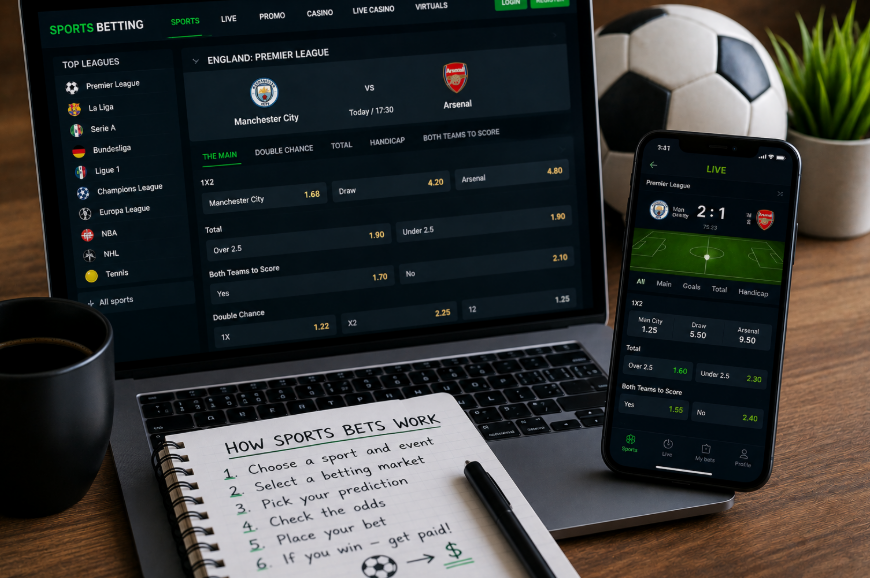
At its core, sports betting is about making a prediction on a sporting event. You are not just watching a match for entertainment anymore. You are choosing a possible outcome and attaching money to that choice. If your prediction is correct, you win according to the odds. If it is wrong, you lose the amount you risked.
This sounds straightforward, but betting is not only about guessing winners. It includes probabilities, pricing, market logic, risk management, and emotional discipline. That is why many people who know sports still struggle with ставки and why even experienced fans can make poor decisions when they move from watching games to betting on them. Understanding the basics helps remove confusion and makes the whole process much clearer.
What Sports Betting Actually Means
Sports betting means placing money on a predicted outcome in a sports event. That outcome can be very simple, such as one team winning a football match, or more specific, such as the total number of goals, points, corners, sets, or cards.
In practice, a bettor selects a market, chooses an option inside that market, and places a wager. For example, someone may bet on:
- a team to win,
- a tennis player to win a match,
- over 2.5 goals,
- both teams to score,
- a handicap result,
- a player statistic,
- a specific half or period outcome.
So sports betting is much broader than simply asking, “Who will win?” The modern betting world offers many ways to interpret a match, and that is exactly why it can feel attractive and confusing at the same time.
The Role of Bookmakers
Sports bets do not exist on their own. They are created and offered through bookmakers — or, using the Russian keyword you requested, букмекеры. Bookmakers are the platforms that publish the matches, set the odds, create the betting markets, accept wagers, and settle the results after the event ends.
In other words, bookmakers are the structure behind the betting experience. They decide:
- which events are available,
- which betting options appear for each event,
- what the odds are,
- how markets are grouped,
- how winnings are calculated,
- how bets are settled in unusual situations.
Without bookmakers, there is no organized betting market. They are the ones who turn a sports schedule into a betting environment.
What Odds Mean
Odds are one of the most important parts of betting. They tell you how much you can receive if your bet wins, but they also reflect how likely or unlikely the outcome is considered to be.
For example:
- lower odds usually suggest a more likely outcome,
- higher odds usually suggest a less likely outcome.
If you place $10 on odds of 2.00, your total return would be $20 if the bet wins. That includes your original $10 stake and $10 profit.
But odds are not just a payout number. They are also the bookmaker’s pricing of risk. This is what many beginners miss. A favorite may look “safe,” but if the odds are too low, the value of the bet may still be poor. So understanding odds is not just about multiplying numbers. It is about understanding what the market is saying about probability.
How a Sports Bet Works Step by Step
The mechanics of a sports bet are simple once broken down clearly.
1. You choose an event
This could be a football match, tennis match, basketball game, hockey game, or another sporting event.
2. You choose a market
For example:
- match winner,
- total goals,
- handicap,
- player points,
- both teams to score.
3. You choose your selection
Inside the market, you pick the exact result you want to back.
4. You enter your stake
This is the amount of money you risk on the bet.
5. The bookmaker confirms the bet
Once accepted, the bet becomes active.
6. The event finishes
After the event ends, the bookmaker settles the bet according to the official result and the rules of that market.
If your prediction is correct, you receive the payout based on the odds. If it is wrong, you lose the stake.
The Difference Between a Bet and a Guess
Many beginners treat betting like educated guessing. That is understandable, but it is not a strong foundation.
A guess says:
“I think this team will win.”
A better betting decision says:
“This team is in stronger form, has fewer injuries, plays better at home, and the odds still make the bet reasonable.”
That difference matters a lot. Betting is not just about whether your pick wins or loses. It is about whether the decision behind the pick made sense in the first place. Good betting habits come from understanding why a bet is being made, not from hoping a result simply goes your way.
Common Types of Sports Bets
To understand how sports betting works, it helps to know the most common types of bets.
Match Winner
The most basic market. You choose who wins the event.
Double Chance
Often used in football. It covers two outcomes instead of one, such as home win or draw.
Over/Under
You bet on whether the total number of goals, points, or other metrics will be above or below a certain line.
Handicap
One side is given a virtual advantage or disadvantage. This is useful when one team is much stronger than the other.
Both Teams to Score
Popular in football. You bet on whether both sides will score at least once.
Player and Team Statistics
You can also bet on more detailed outcomes like cards, corners, rebounds, aces, shots, and many others.
These markets show why sports bets are not limited to picking a winner. A bettor is often trying to understand the likely pattern of the game, not just the final score.
Single Bets and Combined Bets
There are different ways to structure a betting slip.
Single Bet
A single bet involves one selection only. If that selection wins, the bet wins. If it loses, the bet loses.
This is usually the clearest format for beginners because it keeps the risk focused on one idea.
Accumulator or Parlay
This combines multiple selections into one bet. The odds multiply, so the potential return becomes bigger. But every selection must win for the bet to succeed.
This format looks more exciting, but it is usually riskier. Many beginners are attracted to accumulators because of the larger payout, but they often underestimate how quickly extra selections increase the chance of failure.
Pre-Match and Live Betting
Sports bets are often divided into two main timing formats.
Pre-Match Betting
This means placing a bet before the event starts. It gives more time for analysis and is usually the better starting point for new bettors.
Live Betting
This means betting while the event is happening. Odds change in real time depending on what is happening in the match.
Live betting can be exciting, but it also creates more emotional pressure. That is why many beginners do better with pre-match betting first. It allows them to think before acting.
Why People Find Sports Betting Attractive
There are a few reasons sports betting keeps attracting attention.
First, it adds extra meaning to the match. A simple game can feel much more intense when there is a stake involved.
Second, it creates the feeling of participation. Instead of watching passively, the bettor becomes invested in a predicted outcome.
Third, it mixes emotion with analysis. Some people enjoy the entertainment side, while others are more interested in the decision-making side.
That combination is powerful. But it is also exactly why people need to be careful. Excitement can make weak decisions feel stronger than they really are.
Why Beginners Often Make Mistakes
Beginners do not usually fail because betting is impossible to understand. They fail because they rush into it without structure.
Common mistakes include:
- betting on a favorite just because the team is famous,
- choosing very low odds because they seem safer,
- building large accumulators too early,
- betting on emotions,
- chasing losses,
- betting on every interesting match,
- not understanding what market they are actually using.
These are not technical failures. They are decision-making failures. That is why the foundation matters so much.
Sports Betting Is About Risk, Not Certainty
One of the most important things a beginner can learn is that no bet is guaranteed.
A strong team can still lose.
A dominant player can still have a bad day.
A match can change because of an injury, red card, weather, fatigue, or one random moment.
That is why betting should never be built on certainty. It should be built on probability and discipline. Good bettors do not look for guaranteed outcomes. They look for situations where the risk, the logic, and the price all make sense together.
Why Understanding Matters More Than Winning Once
A beginner can win the first few bets and still understand betting very badly. That happens all the time. A few lucky results can create the illusion of skill.
At the same time, a well-reasoned bet can lose because sport itself is unpredictable.
So if someone wants to understand how sports bets work, the real focus should not only be on outcomes. It should also be on process:
- Why was this bet chosen?
- Did the odds make sense?
- Was the market understood properly?
- Was the amount risked reasonable?
- Was the decision made calmly?
That is how betting becomes something more than random clicking.
Source: https://naseebbet.com/